Content Marketing Funnels
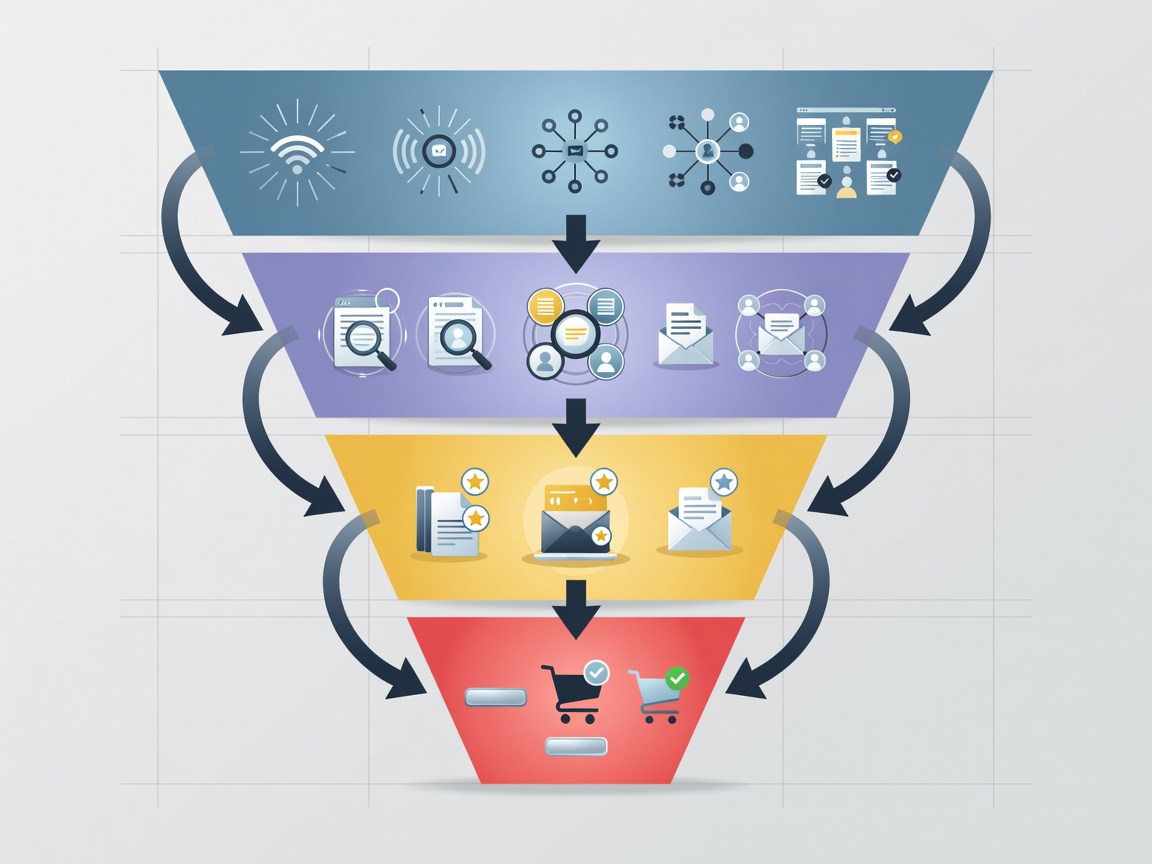
Content marketing is often misunderstood as merely running a company blog. In reality, effective content marketing is a structured mechanism for moving prospects from unawareness to purchase through strategic education and brand positioning.
To succeed, organizations must build a full-funnel content strategy that addresses the specific questions, objections, and pain points a buyer experiences at each stage of their journey.
Top of the Funnel (TOFU): Awareness
At the top of the funnel, the goal is capturing attention and generating awareness. Your audience may not know your brand or even fully understand their problem yet. TOFU content should be highly accessible, educational, and free from aggressive sales pitches.
- Formats: Blog posts, infographics, short-form video, podcasts, and social media threads.
- Metrics to track: Unique pageviews, time on page, social shares, and organic traffic growth.
- Objective: Answer broad industry questions and build a retargeting pool.
Middle of the Funnel (MOFU): Consideration
Once a prospect understands their problem, they begin evaluating potential solutions. MOFU content is where you begin to introduce your methodology and capture contact information for lead nurturing.
This stage requires deeper, more comprehensive resources that prove your expertise. Content here is often gated, requiring an email address to access.
- Formats: Whitepapers, detailed eBooks, webinars, case studies, and email newsletters.
- Metrics to track: Conversion rates on landing pages, lead quality, and email open/click rates.
- Objective: Prove authority, capture leads, and separate highly engaged prospects from casual readers.
Bottom of the Funnel (BOFU): Decision
The bottom of the funnel is where conversions happen. Prospects at this stage know who you are, understand their problem, and are comparing you against competitors. They need hard proof, detailed specifications, and reassurance that your solution is the right investment.
- Formats: Competitor comparison pages, ROI calculators, live demos, detailed pricing pages, and customer testimonials.
- Metrics to track: Demo requests, sales accepted leads, and customer acquisition cost (CAC).
- Objective: Overcome final objections and facilitate the transaction.
Content Decay and Refresh Strategies
Creating new content is only half the battle. Over time, historically successful content experiences "decay"—losing search rankings and traffic as competitors publish newer, more relevant information.
A robust content strategy includes a scheduled auditing process. Identify pages that have lost traffic over the past 12 months, update outdated statistics, expand on sections that lack depth, and republish the content with a current date. Often, refreshing existing content yields a higher ROI than creating net-new assets from scratch.
By mapping content strictly to the buyer's journey and maintaining the health of your existing assets, you construct an evergreen engine for lead generation and brand authority.